 Arab Media & Society The Arab Media Hub
Issue 40, Summer/Fall 2025
http://doi.org/10.70090/AMS.40lmp
The Italian media coverage of the Palestinian struggle from October 7, 2023, to the Freedom Flotilla
There is a long-standing and well-established friendship between the Italian and Palestinian peoples, rooted in religious ties through the Catholic Church — particularly with reference to the Holy City of Jerusalem — as well as in political affinities: both during the fascist regime of Benito Mussolini and, subsequently, in the partisan resistance and the legacy of the political left throughout the 1960s, 1970s, and 1980s.
A significant change occurred with the events of October 7, 2023, when Hamas launched a large-scale attack against Israel from the Gaza Strip, leading 1to the capture of 240 hostages and the death of about 900 Israeli civilians. As is well known, the Israeli government reacted quickly with aerial bombardments of Gaza, ushering in a new phase of the conflict with the stated goal of destroying Hamas and freeing the hostages. Since then, the conflict has escalated dramatically, mainly due to Israeli air raids and military operations that have resulted in a very high number of Palestinian civilian casualties. This represented a repeated crime against humanity and a tragedy perceived on an international scale, so much so that it has sparked a popular reaction in many countries. This situation has generated a political, humanitarian, and health crisis, which – since 2024 and particularly in 2025 – has spread beyond the borders of the Gaza Strip, involving more political forces.
Israel’s response, deemed disproportionate, has deeply shaken global civil society. For the first time, war crimes of this magnitude, documented through videos and photographs, are being brought directly to the attention of world public opinion. Demonstrations of solidarity with the Palestinian people have multiplied and gradually intensified around the world. According to data from the Institute for National Security Studies (INSS) at Tel Aviv University, while in the first six days of the war 69% of protests were against Israel and 31% in its favor, the percentage of demonstrations against Israeli policy has now risen to 95% of total demonstrations in 92 countries. The map of the conflict highlights how the United States and Europe represent the main epicenter of this mobilization, despite the opposition of their respective governments.
The Italian case also fits into this picture. Despite weak calls for moderation, the government has adhered to the US line of unconditional support for Israel, even when military operations have mainly targeted civilian infrastructure and defenseless populations. Reflecting, at least in part, a society that is increasingly critical of automatic alignment with US foreign policy strategies and uncertain about the offensive on Gaza, it is mainly young people, particularly students, who have mobilized in support of Palestine.
This study aims to analyze the narrative strategies of the affair and to understand its instrumental political use. First, it analyzes the general situation of the Italian society’s involvement, with a focus on young people and political forces; then it delves into an analysis of communication strategies through social media; as an exemplary case study, the article uses the now iconic story of the Freedom Flotilla; finally, it analyzes the discrepancy between the underlying political elements, between state, military, and popular actors.
Academic literature on youth political participation considers multiple forms of involvement, from electoral behavior to membership in associations and social movements. Youth voting has long been a central theme in political science studies, which have highlighted a lower propensity for electoral participation compared to older generations, especially in consolidated democracies. This gap is attributed to factors such as a reduced perception of political effectiveness, weak connections with political parties, and dissatisfaction with the available alternatives. In Italy, too, young people seem to have followed this European trend (Andretta and della Porta, 2020).
Despite the electoral growth of protest parties over the past decade, which temporarily reactivated previously disillusioned young people thanks to anti-establishment rhetoric, the subsequent ebb has restored centrality to the process of erosion of traditional political structures and cultures. This trend is confirmed by the recent ISTAT survey on political participation, which reports very low levels of trust in politics and a decline of almost 10% in participation among young people aged 14 to 35 in the period 2011-2023.
At the same time, associations continue to represent an important area of political engagement for young people, acting as a veritable ‘school of democracy’ through which young people develop civic skills, social capital, and a sense of political efficacy. Some studies indicate that, faced with a decline in involvement in formal political institutions, young people tend to turn to local community development activities or the defense of human, social, and environmental rights on a global scale. Although there has been a slight decline in association participation, volunteering is still more widespread among young people than among adults.
However, the sector that has attracted the most youth participation in recent decades remains that of social movements. From the Arab Spring to the climate strikes promoted by Greta Thunberg, young people have shown a strong willingness to take collective action. Social media has amplified this phenomenon, facilitating forms of transnational mobilization and coordination, enabling rapid organization, the dissemination of information, and the visibility of issues ignored by institutional politics.
Italy has a long tradition of youth activism, from the student movements of the 1960s and 1970s to the protests against globalization and the No TAV movement in the early 2000s, to the recent environmentalism. Recent studies confirm that young Italians are more inclined to protest than adults and that exposure to new media encourages participation rather than isolating them in virtual spaces. Mobilizations have also gone through recent critical phases: against job insecurity, university reforms, and austerity policies following the economic crisis; subsequently for the climate issue; and, finally, during the pandemic, with the creation of solidarity networks and forms of self-organization to make up for institutional shortcomings.
However, the mobilizations in solidarity with Palestine are developing in a very peculiar context. Unlike previous experiences, they are emerging in a scenario marked by a “moral panic” fueled by the media and political actors, who tend to equate critical positions towards the massacre of Palestinians with anti-Semitic sentiments. While data show that anti-Semitic violence can be traced back to reactionary and extremist individuals, the most significant reaction to the Gaza conflict appears to be the repression of public demonstrations of solidarity with the Palestinian people, justified by the instrumental attribution of anti-Semitic danger to pro-Palestinian movements and translated into particularly restrictive control strategies.
Precisely for this reason, given the highly hostile nature of the context in which these mobilizations are taking place, it is all the more important to analyze the mechanisms that have allowed the emergence of a coordinated protest according to the classic model of social movements, based on the sharing of resources, values, and common goals by groups and individuals connected through informal networks.
Media Coverage of Palestine in Italy: University Protests
Over the past year, civil society organizations committed to supporting the Palestinian cause have intensified their activities in parallel with the deterioration of the political and humanitarian situation. Protests have spread throughout the country, from north to south, with varying intensity, but with a persistence in media coverage that has intrigued scholars due to its atypical nature. What characterized this cycle of mobilization has been its marked youthful imprint, with about 90% of protests originating in schools and universities. In the fall of 2023, the first promoters of the mobilization were left-wing student collectives and university organizations, whose actions were rooted in political visions developed within activist spaces and based on principles such as self-determination of peoples, internationalism, transfeminism, and the rejection of war and colonial policies. Students began to mobilize through sit-ins, marches, and public assemblies, giving rise to the first occupations within universities or in symbolic locations (Dalton 2020). In Pisa, for example, the removal and replacement of the flag produced an image that was destined to circulate globally, fueling the imagination of a nascent transnational youth movement for Palestine.
Several factors explain the widespread youth participation. First, the central role of social media, described as tools that have allowed access to information perceived as distorted by traditional media. The media coverage was significant, with an overabundance of multimedia material constantly inserted into the global information flow, representing, in fact, the first situation of genocide documented directly by the victims on social media. It can be said that this media pervasiveness, indiscriminate in its distribution on conventional and alternative platforms, has at least transformed the younger generations into direct spectators of the conflict (Chironi et al. 2024).
A further element is represented by the legacy of previous cycles of youth mobilization, particularly those related to climate justice, which have contributed to the formation of new political sensibilities and a greater propensity for solidarity with Palestine. In Padua, for example, a significant role was also played by the mobilization against gender-based violence, which exploded after the murder of Giulia Cecchettin, an event that generated a wave of indignation and widespread participation, to the extent that it became an iconic national case, requiring strong political involvement on the part of parliamentary forces.
Parallel to the expansion of the protest, there was a political attempt to reduce the movement's room for maneuver by resorting to a dynamic of “moral panic” (della Porta 2024). This was evident, for example, in February 2024, when, on the one hand, critical positions expressed in the cultural sphere were excluded and, on the other, repressive strategies were adopted by the police during student demonstrations. In particular, police repression was repeated until the acute phase of the conflict ended, which we identify for convenience of study with the achievement of the Trump peace agreement.
According to PEA data available at the end of 2024, coercive police interventions occurred in 17% of recorded cases, a percentage that drops to 8% when students were not present. Although such interventions were sometimes justified by fears of a supposed resurgence of anti-Semitism, this narrative was strongly contested by students, who reiterated the distinction between criticism of Zionism and hostility towards the Jewish community. At the same time, the solidarity generated around the students helped to broaden the scope of the mobilization and contain the intensity of state repression, especially with the emergence of camps and the spread of protests.
In a context characterized by strong constraints and hostility, the pro-Palestinian student mobilization has emerged as a phenomenon of particular analytical relevance, as it demonstrates the ability of young people to build coordinated forms of collective action through informal networks, the sharing of common values and objectives, and the strategic use of available resources. It is emblematic and significant that the Italian mainstream media have begun to use a dedicated linguistic category, recognized by the term “Pro-Pal,” a contraction of “in favor of Palestine.” This label will be fundamental in analyzing the instrumental contrast with anti-Semitism.
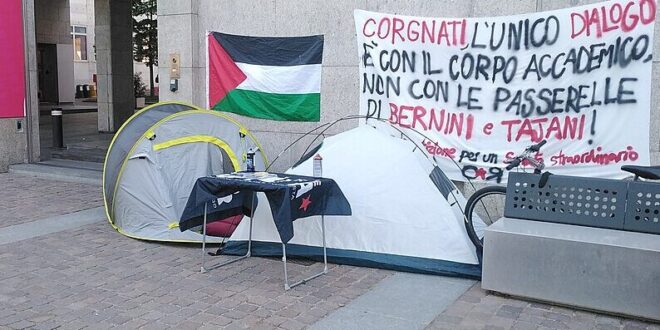
Since its inception, the pro-Palestine movement has been characterized by the use of a heterogeneous and pluralistic repertoire of action, where alongside traditional and conventional forms of protest—such as assemblies, signature collections, leafleting, and information stands—more demonstrative methods have emerged over time, including marches, large-scale national strikes, and symbolic initiatives. Subsequently, especially during the most intense phases of mobilization, direct action practices were added, such as sit-ins, roadblocks, event disruptions, occupations, and university camps. These actions were explicitly aimed at disrupting daily life and drawing attention to what United Nations reports have defined as genocide. However, it was the tents set up on university campuses that became the most evocative symbol of the movement.
In April 2024, a wave of university occupations spread from the United States to quickly reach Europe (Paris, Lausanne, Amsterdam, Madrid, Geneva, Grenoble, Lyon, Lisbon, Barcelona, Brussels, Berlin, Krakow, Ljubljana, among others), but also Australia, Argentina, Brazil, Canada, and Japan. The week of the 76th anniversary of the Nakba, commemorated on May 15, was an opportunity to launch the so-called “student intifada” in Italy as well. On May 8, in Bologna, students set up a camp for Palestine, which quickly spread to numerous universities in large and small cities, from Palermo to Turin, from Naples to Bari, passing through Rome, Milan, Pavia, Parma, Siena, Cosenza, and many others. This widespread symbolic action had a boomerang effect in Italy, where, following the example of their foreign counterparts, students at many universities began residential protests and occupations of university buildings (Mendelsohn et al. 2024).
It is curious how even in the world of state schools there has been a strong awareness of the Palestinian struggle, with particular reference to the ongoing genocide, which has been identified as a serious issue deserving of moral condemnation.
This phenomenon of widespread involvement of young people through coordinated action networks deserves to be examined through the lens of social movement theory, which emphasizes that collective identity formation occurs when individuals recognize shared claims and mobilize through communication channels. The role of informal networks in facilitating this coordination is particularly significant in the Italian context, where university students have exploited both physical assemblies and digital platforms to build what scholars call “networked publics,” spaces where information circulates and collective contexts develop independently of institutional control. The transition from individual awareness of the Palestinian crisis to organized collective action thus reflects a broader pattern observable in contemporary youth activism, in which social media platforms function not only as disseminators of information, but also as crucial infrastructures for building solidarity and sustaining momentum among geographically dispersed groups. This infrastructure proved essential in Italy, where decentralized student collectives were able to coordinate simultaneous actions across multiple universities while maintaining ideological coherence around the fundamental principles of anti-imperialism and the defense of human rights.
The coordination of student mobilizations across geographical boundaries and institutional contexts reveals sophisticated narrative-building mechanisms that go far beyond spontaneous digital expression, including deliberate strategies of information dissemination and counter-framing that deserve detailed examination. To understand these mechanisms, it is essential to recognize how narrative strategies function in contemporary media environments as tools for both mobilization and contestation (Zhai et al. 2025). In the Italian context, pro-Palestinian student movements have employed strategic framing routines that have transformed individual grievances into frames for collective action, using what scholars identify as diagnostic framing—articulating the problem of Palestinian suffering as a humanitarian crisis requiring an immediate moral response—along with prognostic framing that proposes specific solutions such as university divestment campaigns and changes in institutional policies (Mendelsohn et al. 2024). These schemes were not developed organically, but rather constructed strategically through deliberate narrative choices disseminated across multiple media platforms, from university assemblies to social media posts, creating what communication scholars call “cross-media storytelling” strategies that maintain thematic consistency while adapting content to the possibilities offered by individual platforms.
The effectiveness of these strategies depended crucially on emotional resonance, with narrative formats emphasizing human suffering and testimonials generating significantly higher engagement and comments in favor of the movement than expository presentations of political arguments. At the same time, however, counter-narratives emerged through the official communication channels of institutions and the government, which used what has been termed “strategic framing” toward delegitimization, in which pro-Palestinian activism was systematically recategorized through linguistic categories such as “Pro-Pal,” which framed such movements as potential vectors of anti-Semitism rather than as legitimate political expression (Mosca and Quaranta 2017).
This discursive contestation operated through multiple channels: traditional media selectively emphasized incidents of disruption while downplaying substantial engagement with the movement's demands; political actors issued statements equating criticism of Israeli military operations with hostility toward Jewish communities; and police interventions were justified through narratives that portrayed student protesters as security threats. The instrumental use of “moral panic”—a sociological phenomenon in which media, political actors, and law enforcement collectively construct exaggerated narratives of threat around particular groups—functioned as a form of information warfare designed to fragment the movement’s coalition potential and reduce public sympathy.
However, the students’ counterstrategy involved narrative construction work: explicitly distinguishing between anti-Zionism (criticism of state policies) and anti-Semitism (hostility toward Jewish people), repeatedly articulating this distinction in assemblies, on social media, and in direct engagement with skeptical observers. Such a distinction reflected a sophisticated understanding of framing effects, namely the recognition that the way issues are presented linguistically and visually shapes public interpretation and political attitudes. The proliferation of visual images—photographs and videos of student encampments, police interventions, and Palestinian suffering circulating across multiple platforms—constituted a form of visual narrative strategy that conveyed meaning independent of textual explanation, transforming abstract political claims about genocide into concrete and emotionally engaging experiences.
The encampment phase marked a turning point in the nature of the protest: from a widespread but intermittent phenomenon, it transformed into a more structured and continuous movement; its composition changed, its repertoire of action expanded and radicalized, its internal organizational forms were redefined, and the pace of the struggle intensified and accelerated. On the one hand, there was active involvement from the student base, which began to mobilize, with self-managed assemblies, even on a daily basis, and the inclusion of universities traditionally less inclined to protest, such as the European University Institute in Florence, the IUAV in Venice, and UniDolomiti in Belluno. On the other hand, a form of national coordination was established, with university camps linked together through weekly online meetings.
The mobilization also went beyond the student body, involving other members of the university community—researchers, teachers, administrative staff—giving rise to an unprecedented alliance between different roles, which fostered broader and more sustained pressure and prompted demands for universities to take responsibility for their “complicity with war.” One of the most obvious manifestations of this politicization was the national opposition to the MAECI call for scientific and technological cooperation between Italy and Israel, which became a focal point of the protest and led numerous universities to withdraw their participation.
The expansion of the movement inevitably also affected the role of political organizations: while on the one hand more identity-based dynamics emerged, on the other the plurality of the movement encouraged an attempt at unity, accompanied by an awareness of the need to provide tools without representative pretensions, rethinking established organizational methods. In fact, consideration was given to the presence of young people who had never participated in political activities, emphasizing the need to collectively build new forms of occupation of public space.
Political demands and instrumental use
At the same time, the camp was interpreted not only as a form of protest, but also as an expression of prefigurative politics, a space in which the rhythms of everyday life and forms of collective organization were reworked, offering students the opportunity to reclaim university spaces and create an alternative to the alienating environment experienced in the departments. The daily management of the camp posed logistical and relational challenges, requiring a progressive redistribution of responsibilities. “Fuchsia” spaces were also created, dedicated to the prevention of harassment and emotional support, promoting community building and mutual care, partly attributable to the previous work of transfeminist movements. LGBT+ activism played an active role in the battle.
In Sicily, student mobilization merged with the campaign against the Strait Bridge, a project defined by the government as strategic infrastructure for military logistics but interpreted by activists as emblematic of war-oriented capitalist development. The project was also linked to protests against repression. In Veneto, the links between the liberation of Palestine, pacifist activism, and climate protection appeared even more immediate, thanks to the multiple affiliations of many activists with social centers in the Northeast and with the Venice Climate Camp. Overall, through a strategy of convergence, the youth movement for Palestine has managed to bring together different demands and engage the city, intersecting with existing struggles and movements.
This represented a new element in the dialectic of the struggle for Palestine: if in past years participation was characterized by the political banners of opposing parliamentary factions and militant movements, now the opposition has found a sort of common ground, which, however, appears unclear or, probably, open to broad interpretation. This is where the purely political element comes in. In previous years, support for Palestine had been driven primarily by left-wing parliamentary and extra-parliamentary parties, where the battle for Palestine and against Zionism was seen as part of the anti-fascist struggle and in the context of war, recognized as one of the main divisions in the contemporary world. The characterization was that of “Red Palestine,” as a partisan struggle against the occupying oppressor. On the right-wing political side, the division was more marked, between an openly Zionist faction and a minority anti-Zionist faction, which supported Palestine because it was opposed to Zionism as a movement and to Israel as a state, claiming the Palestinian struggle as a nationalist struggle. The current configuration that we want to highlight, on the other hand, has a less political connotation in the ideological sense and a more political one in the pragmatic sense. In fact, there is no official statement on what unites the two distinct factions, which are probably united by anti-Zionism, which is reiterated as distinct from anti-Semitism, and by the struggle against what represents the interests of Western powers with regard to the self-determination of the Palestinian people.
This last passage clearly highlights the intersectional approach adopted by the university movement for Palestine: an intersectionality that serves both as an interpretative lens and a relational method, and which draws on other struggles, such as feminist, anti-militarist, environmentalist, and decolonial struggles. This is why, in demonstrations in the streets, strikes, and universities, the Palestinian flag has often been flown alongside the flags of the progressive movements mentioned above.
One of the tools of colonialism, according to activists, is to exploit the prejudices of Western ideology, according to which the rich world embodies freedom of thought, rights, and civilization, while the Global South—and in this case the Arab community—represents its opposite. This colonial imagery finds its maximum expression in Israel, through narratives such as “Israel is the only democracy in the Middle East” or “the only place where rights exist.” According to activists, this colonial thinking leads to the representation of Palestinians and Muslims in general as inherently misogynistic and homophobic, justifying their domination in the name of Western liberal values. While recognizing that in the Middle East, as elsewhere, there are groups committed to the feminist cause, they point out that feminism is often exploited to legitimize Israel. Furthermore, they emphasize that there can be no salvation for women and queer people under bombardment, stressing the priority of ending the conflict in order to create real conditions for discussion about rights.
How the Pro-Pal movement worked in a communicative war strategy
This curious mixture does not seem to have been examined through a careful and detailed analysis of the cultural, religious, and political values that belong to Palestine, the Arab world in general, and Islam. In a certain sense—and this is the most interesting point—the Palestinian struggle has been ‘Westernized’, becoming integrated into the Western mindset through its languages, symbols, and values. A useful first reference is Giacomo Buoncompagni’s study, published in 2024, which analyzes how the Italian media represented Israel in the period leading up to the escalation of 2023. The author observes that even before the conflict, the narratives present in public discourse tended to favor an imaginary centered on security and the terrorist threat (Buoncompagni 2024). This is important because it shows that many of the discursive structures that were reinforced in the following months did not arise out of nowhere. A framework already existed that made the subsequent polarization more natural and prepared the public to view events through the lens of emergency and defense.
From the point of view of information warfare, the mixture seen ‘on the ground’ in the protests was reflected in the narrative constructed by the Western media. With the outbreak of hostilities, the circulation of manipulated or misleading content increased throughout Europe. In this vein, Hameleers shows that visual disinformation was a central tool of information warfare. According to the author, most of the images or videos circulated during the conflict were not completely false, but decontextualized in time or space, and he observes that visual disinformation consists mainly of existing footage that is decontextualized in a misleading way (Hameleers 2025). In Italy, this dynamic had a significant impact because emotionally powerful content circulates rapidly on platforms such as WhatsApp, X, and TikTok. The power of images, presented as immediate and irrefutable evidence, often prevented critical analysis by the public.
In addition to visual manipulation, the construction of the narrative in Italy was based on selective use of language. A 2025 study found that many European media outlets employed rhetoric aimed at implicitly supporting Israeli military actions. The authors write that some of the media coverage used manipulative rhetoric and misleading facts to present Palestinian groups under the exclusive category of terrorism (Wafi and Zaini 2025). In Italy, this dynamic was visible in the systematic choice of labels such as “militants,” “terrorists,” or “jihadists” to refer to Palestinian fighters, while Palestinian civilian victims often appeared only as anonymous numbers. The way in which those involved are named influences moral perception. If one side of the conflict is defined through a lexicon that evokes fear and aggression, the other side automatically appears to be engaged in a form of defense.
Alongside linguistic selection, another relevant element is the management of empathy in narratives. In most Western media, Israeli victims are often presented with a name, a story, and a recognizable face, while Palestinian victims are represented by abstract figures. According to the authors, this asymmetry produces a form of “emotional distance” that makes it more difficult to perceive Palestinian suffering in its concreteness (Schepens et al. 2025). In Italy, this phenomenon manifested itself in the different treatment given by television news and newspapers in their descriptions of the victims on both sides. Personal stories, especially in the early days of the conflict, came almost exclusively from the Israeli side. The dominant narrative thus offered an implicitly unbalanced picture that pushed the public toward a one-sided moral interpretation.
However, disinformation about the conflict has not been linear over time. Reports from the Italian Digital Media Observatory (IDMO) show a fluctuating trend. In 2025, for example, the Israeli-Palestinian conflict accounted for almost a quarter of all cases of disinformation verified in October of that year (IDMO 2025). In 2024, the percentage was lower but still significant, especially in the months immediately following the start of military operations, when the topic accounted for over 12 percent of fact-checking cases (IDMO 2024). These data suggest that the information war depends heavily on peaks in media attention and developments in the conflict. When events become more dramatic, the production and circulation of manipulated content automatically increases.
It should also be noted that the Italian narrative is not isolated but part of a global network. Hameleers states that the construction of partisan truths through images and emotional content is now a transnational phenomenon affecting various international conflicts (Hameleers 2025). The study by Wafi and Zaini confirms that many European media outlets have adopted similar strategies, despite political and cultural differences between countries (Wafi and Zaini 2025). Consequently, dynamics that respond to broader trends in the Western information system can also be observed in Italy. The narrative is not only constructed within the country but is fed by the same sources, the same images, and the same interpretative frames that circulate in other contexts.
While sharing a common matrix with other European countries, Italy also has its own specific characteristics. The issue of immigration, the presence of communities of Middle Eastern origin, and a strong political sensitivity linked to internal security have contributed to amplifying certain narratives. In many cases, the conflict in the Middle East has been interpreted through codes that recall the debate on the management of migration flows, alleged cultural incompatibility, and the risk of radicalization. The war has thus been used as a metaphor for internal Italian issues and as a tool to fuel fears or political identities.
The consequences of these strategies are significant. The polarization of public debate has become more intense. Digital communities have quickly divided into opposing camps, often unable to engage in dialogue with each other. The dehumanization of Palestinian victims has reduced awareness of civilian suffering (Al Shebli et al. 2025). Furthermore, the frequent use of selective doubt about Palestinian sources has undermined confidence in information documenting war crimes or violations of international law. All this has made it more difficult to form an informed and aware public opinion. Nevertheless, the often-confusing mix of information and the resulting construction of an ambiguous narrative framework confirms that the information war remains a structural problem for the collective West and an equally significant problem for the Palestinian struggle itself, which is exploited according to the narrative utility of political forces in order to neutralize its ideological identity.
The case of the Freedom Flotilla and the disarticulation between Islamic countries, the Resistance, and Palestine
The Freedom Flotilla incident, which emerged as a central symbol of this broader movement, exemplifies how particular events become focal points of the narrative; the flotilla’s journey to Gaza, its interception, and the subsequent student mobilization around its symbolism created what narrative theorists identify as a main narrative, a general story that integrates multiple subordinate narratives into coherent frameworks of meaning-making that explain past events, justify present actions, and orient future possibilities. It is here that we can accurately observe the above.
The dimension of the information war, as mentioned, intensified when state and institutional actors sought to neutralize the narrative power of the movement through censorship, police surveillance, and restrictive administrative policies—tactics that paradoxically amplified the movement’s visibility by generating further events (police interventions, administrative repression) that confirmed the movement’s counter-narrative about institutional hostility toward dissent. This dynamic reflects broader patterns in digital media environments, where attempts at narrative suppression often generate boomerang effects, in which efforts to contain information instead accelerate its circulation and amplify its perceived significance (Zhao et al. 2024).
The information war was therefore not unidirectional, but rather constituted a contested terrain in which multiple actors deployed competing narrative strategies, each attempting to establish definitional authority over the meaning of events and the legitimacy of political actors, with the outcome determined not only by the accuracy of information, but also by the relative ability of different actors to reach audiences, mobilize resources, and construct emotionally engaging narratives in line with the public’s existing worldviews and political commitments. It is therefore useful to retrace the historical process of the narrative construction of the Freedom Flotilla. In its recent version—quite distinct from the 2010 attempt—the Flotilla began as an officially popular initiative to support the Palestinian population with humanitarian aid. Unlike previous missions, this new Flotilla was organized by a broader coalition of NGOs, doctors, activists, and parliamentary delegations, with the stated goal of delivering essential aid and denouncing the impact of the blockade on the healthcare system and the living conditions of civilians.
Between spring 2024 and summer 2025, several attempts to set sail were delayed or thwarted by diplomatic pressure. The ships, coming from Mediterranean ports and supported by international networks, carried medical supplies, food, water purifiers, and emergency equipment. The Flotilla was primarily symbolic in nature. The organizers called it a “civilian bridge” to highlight the suffering in Gaza and openly challenge the restrictions imposed by Israel.
In 2024, one of the main ships, then named Sumud Flotilla, carrying medical personnel and international observers, was stopped in international waters by Israeli naval units, which prevented it from advancing towards Gaza. Despite the lack of armed clashes, the operation generated diplomatic tensions and protests in various European countries. In 2025, the coalition attempted a new mission, this time with a modified route and a broader composition of organizations. This voyage also ended in interception, but it attracted more media attention because it was documented live by journalists on board. The Freedom Flotilla 2024-2025 did not achieve its goal of breaking the blockade, but it had a significant symbolic impact. The missions brought the humanitarian crisis back to the forefront of public opinion, fueled the debate on international maritime law and the proportionality of security measures, and showed how civil societies and non-governmental actors are still trying to intervene where traditional diplomacy fails.
The way in which the Flotilla was reported by the Italian media followed an irregular pattern. We can distinguish a first phase, relating to the first attempt in 2024 with the Sumud Flotilla, in which the initiative was demonized by the mainstream media as a non-institutional initiative, not attributable to a single international actor and not easily framed within a political context. Subsequently, the media narrative changed as a result of widespread popular support and intensifying protests by citizens. The Flotilla, now in its second attempt under the name Freedom, became a symbol of a humanitarian effort that transcended political and religious ideologies, while for Israel it meant increased criticism on a global scale, as military intervention against a humanitarian convoy represents a serious violation of international law.
At this point, the mainstream media, which tended to be against the Pro-Pal movement, began an operation to appropriate the cognitive and informational domain of the struggle for Palestine. The Freedom Flotilla, being a significant international case, was absorbed by the media system, and the narrative of the Palestinian struggle became subject to manipulation by the institutional media system. It was at this stage that many Italian politicians expressed their support for the Palestinian cause, abandoning their support for Israel only temporarily in order to exploit the wave of indignation for their own political gain.
What happened in parallel was the defusing of the protest and the gradual dissolution of the so-called Pro Pal movement. This happened gradually, until it was completely neutralized around October 2025, when the peace agreement proposed by US President Donald Trump was reached. At that point, the mainstream media narrative changed again and the Pro Pal demands were abandoned, offering an interpretation of events aimed at rehabilitating Israel and its role in the region and on the world stage. It should be noted that the dissolution of the Pro Pal movement was also made possible by its heterogeneous constitution. At least as far as the Italian case is concerned, which we have discussed in this analysis, there is a marked discrepancy between three main elements: what the Islamic countries that support this battle are; the Axis of Resistance as a military instrument of some of those countries; Palestine as a political, cultural, and religious entity (Henarni and Surwandono 2024).
In this case, the Italian public does not believe that the three elements constitute a continuity, either formal or ideal. With regard to the Muslim-majority countries that support the Palestinian cause, the Italian Pro Pal movement has been characterized by a strong opposition to the principles of Islam, the lifestyle, symbols, and customs of the Islamic tradition. In particular, the demonization of the Islamic Republic of Iran has never ceased, except during the brief period of the twelve-day war in 2025, when a minority of the Italian media supported Iran against Israel’s military aggression, but with the reservation that this support was only in reference to the military aggression, not because of Palestinian support.
As for the Axis of Resistance, it has been continuously demonized and deliberately dissociated from the Palestinian struggle. In particular, the media have continued to portray the Axis as one of the causes of the outbreak of the conflict, not as a solution, nor as an element in favor of Palestine and its liberation. This has been evident since October 7, 2023, and even more so as the conflict has continued, with Western media supporting Palestine, but only in a defensive logic against Israeli aggression, while consistently condemning Hamas and all other armed resistance movements, including Hezbollah, even during the period when Israel attacked Lebanon to counter the activities of the Axis of Resistance (Majid et al. 2025; Al Shebli et al. 2025).
In a sense, the Italian narrative deliberately excluded elements representing the Palestinian struggle. In this way, the struggle was partly distorted and transformed into an ideological battle, just like many other Western ideological battles. This is why some ideological movements that are distant from the values of Islam, but also of Arab Christianity, such as LGBT+ movements, were able to join the Pro-Pal movements. By distorting the real reasons and aims of the Palestinian struggle, it has become, in the eyes of Italians and Westerners in general, a battle of an oppressed minority that needed a voice in the media arena. The entire ideological and religious apparatus of the Palestinian struggle has been excluded from the Italian public’s narrative and understanding.
In conclusion to this analysis, we can say that the communicative frame of the Palestinian struggle in Italy, from October 7, 2023, to the present, has been characterized by three historical phases: (1) contrast: the presence of Hamas and the Zionist tendency of the Italian media refused to observe the situation of the Palestinian struggle from the point of view of law and international relations, favoring criticism of Palestine and limited events; (2) due to the exponential increase in protests and popular support for Palestine, with the escalation of genocide and other divisive events such as the attack on Lebanon and the attack on Iran, the Italian media adopted a strategy of acquisition and contamination of the cognitive and informational domain, saturating the construction of the narrative framework; (3) gradual decrease in media coverage, until the peace agreement brokered by Donald Trump, returning to a politically correct narrative towards Israel and Zionism.
On the ideological and identity level embodied by the population, in parallel, we have had equally evident phases: (1) growing participation in the name of opposition to war and ethnic discrimination, including the case of the Flotilla humanitarian expedition; (2) exploitation of the political opportunity to integrate other types of social struggles; (3) dissolution of the movement at the end of the hostilities, abandoning the Palestinian cause as something limited to specific events and not as something ideological and existential.
The lack of awareness of the existential and ideological dimension of the Palestinian struggle, together with the artificially maintained dissociation between Islamic countries in conflict—the Axis of Resistance—Palestine, as well as careful media management, meant that the struggle for Palestine ultimately became just another social struggle, motivated by the Western model of human rights and, therefore, adaptable to the mentality and political utility of the West.


