Arab Media & Society The Arab Media Hub

Issue 40, Summer/Fall 2025
http://doi.org/10.70090/AMS.40doaad
Abstract
Supplanting the sensationalized news coverage of traditional media with a humanitarian narrative agenda, alternative news websites, freelance journalists and educational accounts are gaining prominence among MENA young creators. While the literature on political communication, technopolitics and network analysis has shed light, in recent decades, on Social Media platforms’ potential as new territorialities of narrativization, and transnational activism, there remains a need to reorient the focus towards exploring the content and reach of the contemporary news/content providers. In order to assess Instagram’s relevance and impact as a news source, and its oscillation between a platform for solidarity politics and resistance politics among the MENA creators, this research advances, through multimodal content analysis of selected Instagram posts, a snapshot into the defining features and visual strategies that distinguish the selected Instagram accounts from other mainstream media.
Introduction
Social media platforms have rebranded beyond their initial objectives. Initially conceptualized as spaces to connect or network with friends, family and people you know or to share moments (pictures), and discover new content, social networking sites (SNS) have expanded to become a space for participation and engagement beyond national boundaries. The accessibility of these platforms and their democratization now means that politicians can directly engage with constituents. It also signifies that a plethora of other actors ranging from large corporations to average citizens can disseminate real-time updates, share public statements and debate policies, thus democratizing information access. The co-existence of state actors, alternative media outlets, and politically oriented users on these platforms highlights these platforms’ paradoxical role as outlets for both the dissemination of state propaganda and the articulation of grassroots perspectives.
Moving beyond the macro-political discourse, in the specific context of the Middle East and North Africa (MENA), the Arab Spring uprisings in the early 2010s first signaled the onset of the transposition of the organic and vernacular political communication into the networked sphere. Officially politicized and having effectively contributed to the materialization of bottom-up articulations into watershed moments of on-the-ground action, the networked sphere provides political communication scholars with a variety of unique cases to problematize the links between apps and democratic engagement, among other aspects of digital politics.
Though Facebook and Twitter represented the central app for amplifying political grievances in the years leading up to the Arab Spring, the nature of user habits has recently shifted towards other platforms such as Instagram and TikTok. Though only three MENA nations (including Egypt and Iraq) can be found in the top 20 for reach on Instagram, this platform – now part of Meta – provides unique features that are being leveraged to mediatize the current critical transformations occurring in the region (Radcliffe et al. 2023). Spotlighting the Insta sphere, this study attempts to contribute to the discussion on the underlying features of youth discourse-activism and power structures in the sociotechnological system as the region undergoes a trajectory of intense rediscovery and reinvention. Combining insights from political communication studies and digital media research, this article delves into the MENA region political creator culture on Instagram through a representative sample of posts from 11 public accounts to identify characteristics that distinguish this digital sphere of engagement from leading account categories and multimodal practices (Kress and Van Leeuwen 2001) that reflect how users leverage the platform’s affordances to mediatize politics.
Literature Review and Theoretical Framework
As Instagram emerges as yet another component of the new – digitized and networked – public sphere and as a key node for distinct political communicative styles, it offers an additional layer to the study of social media and users’ behaviors – succinctly, how they leverage the platform’s affordances to creatively shape their narratives. Before descriptively categorizing the actor types and content preoccupations dominating the mediatization of the MENA region within the studied sample, this section situates Instagram political expression within the ongoing momentum of social media in Arab politics through the lenses of multimodality (Jewitt, Bezemer, and O’Halloran 2025; Kress and Van Leeuwen 2020), affordances, and connective action (Bennett and Segerberg 2012).
The Legacy of the Arab Spring: Social Media and Political Expression
The experience of the Arab Spring in its multifaceted consequences – democratic transition, consolidation of dictatorships, civil wars – has culminated in the cultural resonance of the ‘social media for political change’ ideal. Though it must be clearly communicated that, for the younger generations, the Arab Spring represents a distant memory, this generation which reaches socio-political maturity by the end of the decade following the 2011 upheavals seems to have adapted in its own distinct ways to the potential of the decentralized structure of digital networks in driving national, regional and international engagement. This present endeavor features under the growing literature on the socio-political restructuring of the public sphere in the aftermath of the technopolitical turn in the MENA region through one specific dimension: the alternative communicative spaces of young actors on Instagram.
The role of digital media was spotlighted in the literature in the immediate wake of the Arab revolutions, most prominently in the concept of “liberation technology” (Diamond and Plattner 2012). The predominant narrative that emerged during this period to “tell the story of political change” and explain the processes of potential democratization was one where the “Internet, mobile phones and social media … made the difference” (Howard and Hussain 2012). Indeed, while the underlying factors that have pushed people to mobilize from Tunisia all the way to Yemen included a combination of region-wide grievances but also nation-specific particularities, the consensus remains that the networked sphere (more prominently, Facebook and then Twitter) played a pivotal role in transforming “individualized [and] localized … dissent into a structured movement with a collective consciousness” (Howard and Hussain 2012).
While the apps’ momentum in driving political change has been supplanted by the reality of “digital authoritarianism” – i.e., the high and low-tech countermeasures adopted by governments to “monitor activists, journalists … and diaspora communities” – the Arab revolutions left behind alternative pathways of political agency that are gaining traction in research at the intersection of digital activism and political culture (Jones 2022; Tactics Institute for Security and Counter Terrorism 2025). A model for sustained action by decentralized and horizontal spheres of engagement that have been alternatively described as “networked politics of contention” have emerged (Zayani 2015).
This framework of networked contention evinces, indeed, creative counter-reactionary instruments of mobilization that seem to depart with the logics of collective action to adopt a connective action rationale (Bennett and Segerberg 2012). Horizontality as a model for engagement explains the shift towards what have been described as networks that are more based in “activist frameworks unrestricted by the hierarchical nature that governs ... classical political work” – for instance, unionization (Amor 2025). Departing with the traditional structures of social group identity, membership or ideology, this form of activism is facilitated, first and foremost, by digital media and the connective potential it allows. For the sake of this study, it is acknowledged that the diverging national political environments across Arabic-speaking countries generate a spectrum of engagement — ranging from participation and slacktivism to networked cosmopolitanism and the formation of clandestine digital enclaves. In this sense, while accounts with similar objectives may produce cognate content in articulating political grievances, aspirations, and celebrations, the typology presented here is only representative of the curated, visible space on Instagram.
The Insta Sphere: Echo Chambers, and Networked MENA Politics
Spotlighting the research field site, this section seeks to answer the question ‘why Instagram?’ Instagram presents a “socio-technical” system and a unique space of inquiry combining features that can be found across other social media and social networks (Ferrara, Interdonato, and Tagarelli 2014). Originally conceived as a photo-sharing platform for mobile users, its launch in 2010 allowed for a laid-back, amateur photo blogging ecosystem. Its structural characteristics, however, also gave way to the possibilities of establishing social relations and interactions – from direct messages (DM) functionalities to the likes, comments, and shares features. At the time of drafting this article, Instagram expanded to include tools such as stories (temporary posts which last 24 hours), reels (short-form videos), highlights (allows for keeping stories accessible on the feed), and threads, among others.
Though for the scope of this study focus is placed on the discourse, formats, and aesthetics of the sampled content, engagement on Instagram is understood as both the practice of creating and sharing news and/or information. The platform is led by ‘prosumers.’ Coined in the 1980s, the concept refers to the amalgamation of producers and consumers in one actor (Ahluwalia and Miller 2015). Repurposed to describe interactions in the social web, ‘prosumption’ is best understood in the notion of the participatory public culture that the social virtual sphere presents. Posts online, as Pompilius (2021) puts it “are in fact made by the very users of the application, or the consumers themselves.” Furthermore, content demands interaction as it has no impact if it is not ‘liked’ and ‘shared.’ Beyond the act of creation, re-sharing existing content thus furthers the act of prosumption.
While sweeping claims cannot be made about user experiences, the literature does consistently identify several – oftentimes, contradictory – processes. There exists, for instance, a social responsibility attached to the act of creation on Instagram which Hassoun et al. (2023) refer to as “information sensibility.” The aesthetic, the social and the informational are entangled online and users, including, “Gen Zers [oftentimes] interpret information as aspirational members of a social group, not as isolated individuals” (Hassoun et al. 2023). The aspect of “social belonging” voiced out by interviewees in this study suggests that youth are more inclined to engage with news and/or information online if they trust its source or if it seems relatable to their styles of expression.
For Gen Zers, “information journeys do not begin with a truth-seeking search query” nor are they linear. They rather switch between “information-seeking and “information encountering” (Hassoun et al. 2023). Instagram presents the optimal space to “encounter” news because of its affordances. Algorithmic recommendations based on users’ previous behavior and social graph – i.e., followed accounts and followers – create the “echo chambers” which entrench individuals in their viewpoints and limit exposure to counter-narratives (Burrows 2023). Insta users, consequently, engage in a closed feedback loop which makes this study, in a sense, an investigation of a one self-reinforcing space of political communication on Instagram.
The echo chamber – or the bubble – effect is rooted, indeed, in the social identity theory which is predicated on the fact that individuals gravitate towards the consumption of content that reflects their existing “‘in-group’ connections” while eschewing “‘out-group’ viewpoints” culminating in the process in “homogeneous networks that bolster in-group cognition” (Dutta et al. 2025). While this article thus acknowledges the inherent “selective exposure and confirmation bias” which proliferates in the studied field site, it also frames the insularity of the chamber as methodologically and analytically advantageous – rather than as a limitation – for the purpose of tracing the spectrum of the digital-political communicative habits across the representative sample of young MENA creators (Dutta et al. 2025).
The echo chamber can be further understood – beyond its structurally isolating and polarizing logic (Cinelli et al. 2021) – as a space for “connective action” embedding users within a loop of their own strategic platform navigation (Bennett and Segerberg 2012). Without overlooking the immense power of the “custodians of the Internet” and “the hidden decisions” that shape the user experience, key processes such as “selective visual attention” must be acknowledged as “individuals focus on specific elements based on their attributes” (Gillespie, 2018; Shail et al. 2023). The platform, as such, constantly reconfigures user agency as they engage with a blended ecosystem where hard news is entangled with opinionated and personalized content.
Linking the logic of connective action (Bennett and Segerberg 2012) through social media platforms – which evinces a “typically far more individualized and technologically organized set of processes” – to the multimodality lens, allows for richer representation and thus interpretations. Connective action on Instagram – or otherwise – is understood as “personalized action formation” as it results from an expression of “personal hopes, lifestyles, and grievances” (Bennett and Segerberg 2012). It is thus linked to the formation of what have been dubbed as “flexible ‘weak tie’ networks” of engagement which, in the scope of this research, is framed as a self-motivated, personalized content creation (Bennett and Segerberg 2012). On the Insta sphere, connective action is, indeed, enabled and constrained by the multimodal array of affordances available to users.
Multimodality and Platform Affordances
Social media discourses operate “as assemblages of multisemiotic repertoires, privileging the visualization and generativity of meaning through integrating multiple resources” (Simungala et al. 2025). On Instagram, these resources consist in assemblages of texts, audio, and visual modes of meaning-making that combine to inform a set of socially, politically or culturally driven articulations and actions. Having established that connective action – or the “digitally networked action” – as conceptualized by Bennett and Segerberg (2012) begins with an “array of personal action frames that spread through social media,” multimodality can be understood, as such, through the lens of social semiotics. While the connective action frame should not be decoupled from the collective action – the potential transformation into organized offline mobilization – for the sake of this study, we are concerned with the meanings that emerge from digital communication and not its on-the-ground impact.
The social semiotic aspect of multimodality, as theorized by Kress (2010), is relevant in the analysis of digital political communication as it allows us to infer how users deploy certain semiotic resources over others to articulate certain meanings, optimize visibility or strategic invisibility, and reach a target audience. In their “multimodal discourse analysis of selected social media posts on the #BlackLivesMatter protest,” for instance, Ahaotu and Oshamo (2023) contended that the interdependence of the verbal and visual elements allowed for the articulation of unified themes – ranging from solidarity to global activism – that standalone words or images could not have aptly conveyed.
It is through the lens of the interdependence of meaning-making resources as afforded by the platform in itself that we approach the study of a purposively selected sample of Insta MENA politics-related posts. This research as such attempt to offer a further layer to established scholarship on the changing landscape of political expression in the MENA region by providing a snapshot into the Insta political practices. It seeks to address the following research questions: What account types are represented in the selected Instagram corpus? and What are the main objectives, themes and multimodal strategies shaping their key narratives? It, consequently, provides a dual contribution filling a platform-specific gap within a particular geopolitical context – since it offers a media-centered analysis of Insta’s repertoire (discourse and aesthetics) surrounding the MENA political context.
Research Design
To curate the data sample, this study relied on an initial phase of immersion in the Insta public sphere. The approach, however, did not consist in traditional ethnography – i.e., a sustained co-presence over a long duration (Hine 2015) – but rather in a reworking of the “lurking” method which Strickland and Schlesinger (1969) place “somewhere between participant-observation and what some authors call ‘complete observation’ or ‘non-participant observation.’” While in modern usage ‘lurking’ – or in social media slang ‘creeping’ – consists in the passive scrolling through the content without active interaction, the practice can be reframed in light of the emergence of politically volatile, polarized, or censured spaces as a strategic navigation of sensitive discourses.
This research method, indeed, builds on this rationale to curate the data log placing the researcher at the “periphery of the setting in such a way that he is ‘present’ but is not required by the situation to interact extensively with others;” especially, as the final aim is to collect a representative sample of the vernaculars employed by the young users of the MENA space instead of establishing a dialogic interaction with the users. The choice to recalibrate this methodological framework further stems from its relevance “in conjunction with content-analysis, as established by Strickland and Schlesinger (1969). The research then moves to the multimodal discourse analysis phase. This study peruses and analyzes a representative corpus of 55 Instagram posts across 11 accounts reporting on MENA-related political issues to identify thematic clusters and aesthetic patterns within the data and uncover the interplay between language and aesthetic strategies.
Data Collection and Analysis
In light of Instagram’s mechanism of feed personalization and customization building on prior interactions (likes, comments, followers), a new Instagram account was set up devoid of prior user history. To further avoid cross-platform contamination – especially, as Meta allows for linking accounts across its apps – the account was isolated from the author’s existing digital footprint with the use of a separate email. For data acquisition, a general key word and hashtag search was conducted capturing the ongoing or scheduled events at the time of writing this article (May 2025). In this sense broad key words such as MENA Politics and MENA region were progressively narrowed to more specific key words and hashtags such as Gaza, and #SudanUpdates. Furthermore, the suggested profile feature as well as the tagged location feature set the path for content discovery of similar accounts and geographically specific data.
A manual crawling strategy – otherwise described as human-led network tracing or as previously mentioned ‘lurking’ – was used for data acquisition. This consisted in perusing the posts that topped the explore search page and tracking the sharing or tagged accounts which were compiled in an Excel sheet with identifying the metadata (username and follower count). This pre-coding method allowed for an overview of the visible network. Before the selection of the definitive corpus, the initial data log documented the discovery source, the source for account type classification, a 5 baseline posts frame, and dominant media modalities across this subset (see Index A). The descriptive pre-coding was built on a combination of self-articulated criteria from the accounts’ bios or captions – i.e., through in vivo (verbatim) categorization – and deductive coding guided by pre-determined media formats (Saldaña 2016). This study is, notably, contingent upon the “embodied” experience of the researcher as it adopts an open approach which departs with a pre-meditated selection of what elements or which accounts to study. Instead – and in a conscious approach to capture the purposive sample in its authenticity – the manual navigation and observation phase determined the selection of the representative corpus.
Inclusion Criteria
The final sample was adopted, first and foremost for the purpose of selecting multimedia content that would allow us to delve into the interplay between text, audio and visual elements categorized into videos (high-production video with textual overlays, amateur selfie-style videos, memetic and audio-driven trendy videos) and images (static image, multi-slide carousel, raw photo-journalistic imagery, text-only images). The sampling further adopted the following inclusion criteria: accessibility and public visibility (public accounts discoverable in the explore page), and active status (with at least one post at the time of data compilation). Audience reach which was assessed through the follower count (10K+ followers) and a minimum engagement rate. This was set at 1 per cent with the application of the following formula across the latest 5 posts in each account during the time of the data selection and analysis: (likes + comments + shares) / followers x 100 (see table 1 for engagement rate). As such, while the initial log included posts that went back to October 2024 (@mohammedHarar2), the account was excluded pm the basis of the active status criteria. The rest of the selection was based on prioritizing content diversity – as the final aim of this article is to analyze the use of multimodal elements in selected Instagram content. In this sense, in the accounts that showcased similar design, the account with higher engagement rate was selected.
Other elements considered in the selection were: relevance to Gen Z expression style through identifying markers such as the use of memes, slang, emojis, among others. The youth-led (based on verbatim coding, self-disclosed as “student-led” or based on the age of the creator) accounts were also considered. The political relevance comprised the primary indicator across all accounts: content was chosen only if it is explicitly linked to a specific MENA national context or a region-wide issue.
Data selection began specifically in May 2025. Given the 5-post frame, the final sample ranged between May 2025 to March 2025 in accounts that are either inactive or follow posting schedules Focus was placed only on content that is created and distributed by the account itself and not on tagged posts on the feed
Ethics and Positionality
This sub-section seeks to account for a few considerations that underpin the research methodology adopted. Since this study was not conducted from the point of view of quantification, the corpus in this specific article is not intended for a statistical mapping of all accounts engaged in MENA political discourse. It rather seeks to capture a repertoire of the ways in which the selected creators construct and frame MENA-related news and information.
To validate the authenticity of accounts selected, a careful scrutiny of the “about this account” section of Instagram was conducted to verify creation dates, location and potential handle changes. This allowed for a verification of whether (a) the accounts were created against the backdrop of certain events or (b) they are newly created or (c) they have rebranded and became more active in the wake of a key geopolitical node. Furthermore, the frequency in username changes and/or discrepancy between posts and location was examined given their validity specifically for the witness-based category (see section 1 of the findings) and since they constitute markers of potentially fake accounts – i.e., showcasing coordinated inauthentic behavior.
While the main objective of the methodological approach constituted an attempt to generate a diverse sample that captures the multimodal content enabled by the Insta sphere’s affordances, the following limitations must be acknowledged. First, while the sample allowed for thematic saturation and consistent style detection, its relatively small size precludes generalizability. The sample is, indeed, not comprehensive and only captures the multimodal elements used in the compiled corpus. The analysis, however, does capture a certain diversity in the posts, allowing this study to feature within the scholarship on the novel forms of interaction and engagement. Second, it must be acknowledged that undetected inauthentic engagement remains a possibility as is common across digital media research, in general. Third, while the choice of platform is thoroughly accounted for in terms of its growing popularity among young users and the unique structural characteristics of the Insta ecosystem, it must be highlighted that results are only Instagram related and only a cross-platform comparative study can ascertain whether similar trends are notable in other social networks.
Findings
Analyzed Instagram corpus reveals miscellaneous yet interconnected forms of political communication that reflect an overall transition in the discursive and aesthetic elements of political mediatization on social media. Curated content allowed for the categorization of the Insta accounts reporting on MENA politics into 5 groups as classified in table 1.
Table 1: The typology of selected Instagram accounts and their average interaction ratio.
| Type of Account | Handle | Average interaction ratio (%) |
|
Witness-based reporters (citizen journalists/war influencers) |
@wizard_bisan1 | 8.15 |
| @2jomaa | 6.88 | |
| @saleh_eljafarawi* | 15.84 | |
| @mahmoud.b.shalha
|
80.18 | |
| Educational accounts | @letstalkpalestine* | 4.34 |
| @sudan.updates
|
2.61 | |
| Community | @sudansolidaritycollective | 2.01 |
| @makanrights
|
3.49 | |
| Think tanks / research institutes | @al.shabaka
|
2.87 |
| Independent news outlets | @inkyfada.media | 1.83 |
| @raseef22 | 1.13 |
*@letstalkpalestine is a network of Instagram content posting in 7 different languages (English, French, Spanish, Portuguese, Deutsch, Italian, and Arabic) across 7 different accounts. In this study’s findings, we relied only on the account posting in English.
*@saleh_eljafarawi’s official account (75.3k followers) was deleted by META at the time of the writing of this article (May 16, 2025).
Witness-based Reporters: Citizen Journalists and User-War Influencers
In addition to the self-disclosed criteria, the classification of the creators was based on the content-driven analysis of their multimedia posts. By delving into the set of auditory, visual and textual elements (captions as well as through the overlay technique) consistent across the 5-post baseline, we eventually moved beyond the initial descriptive labels to establish the sample-specific typology. The 4 creators classified under the witness-based label evince a video-based content that ranges from the messy to the professional. These videos translate stylistically informed decisions based on the objective of the video, its target audience, and potential intended distribution by another media vector.
Emerging in times of active wars, witness-based communities seem to garner more attention than any other existing actors on social media – as the interaction ratio with their posts shown on the table above indicates. Based in the war zone, relying on limited resources, and covering news as they transpire, these prosumers are redefining the “methods of engagement and communication during crises” (Divon and Krutrök 2025). In Palestine, the ongoing genocide has occasioned a proliferation of a network of witness-based accounts simultaneously documenting the war from different locations, especially from Gaza. With a view to achieving the objective of garnering a comprehensive overview of content formats, the selection of accounts under this category was based on a perceived variation in content both in terms of filmic style, used language, and professional affiliation with established news outlets. Witness-based accounts can, as such, be classified as (a) citizen journalists or (b) user-war influencers – @wizard_bisan1 (Bisan Owda) straddles both models. Though previous studies (McCurdy 2013; Divon and Krutrök 2025) on war documentation include celebrity-war influencers – i.e., celebrities who leverage their pre-existing fame to mobilize support for a cause – for the purpose of this study, the perused accounts did not yield this category. It must be noted that accounts referenced in the witness-based classification are all run by young people and not merely targeting this cohort.
Generally, the practice of citizen journalism combines amateur-video making with semi-professional news coverage. The same holds for the selected Palestinian journalists. @mahmoud.b.shalha’s biography on Instagram indicates that he collaborates with Al Jazeera channel as a photojournalist while @wizard_Bisan1’s videos end up on the reports of Al Jazeera Plus (AJ+) – the social media publisher owned by Al Jazeera network. The reports published across the social media accounts of AJ+ (on Instagram, but also on Facebook, X, and YouTube), featured, among other examples, Bisan Owda’s documentation of “the journey of Palestinians returning to Rafah” (@ajplus 2024).
On May 17, 2025 @wizard_Bisan1’s video content showcased the recourse to the multimodality afforded by the Insta sphere in her call for people “to take to the streets as if the genocide has just begun,” as the caption reads. The video alternates between crisis traces – as the camera places her in focus against a starkly dark background wearing a traditional Kufiyah – and a polished informational package featuring screenshots of articles, media-extracted videos, and text graphically superimposed on the video frame fluidly (see figures 1 and 2).
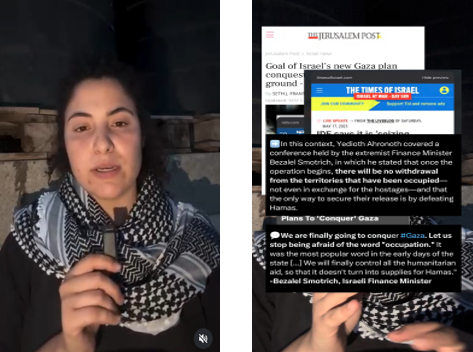
Figures 1 and 2: Bisan Owda calling her viewers to action.
Source: @wizard_bisan1, May 17, 2025.
A convergence of the visual and auditory resources similarly emerges across @mahmoud.b.shalha’s content further showcasing the raw periphery of the conflict zone through selfie-style low-fidelity videos combined with unfiltered ambient audio from the ground. On his shared post on May 18, 2025, the caption which reads “a gathering of citizens targeted during the excavation of a water well in Northern Gaza’s Al-Saftawi district” [translated from Arabic] distills the multimedia content (Figure 3). Both examples showcase an interdependence between the semiotic elements of the content as the caption for, instance, abridged the urgency showcased in the videos.
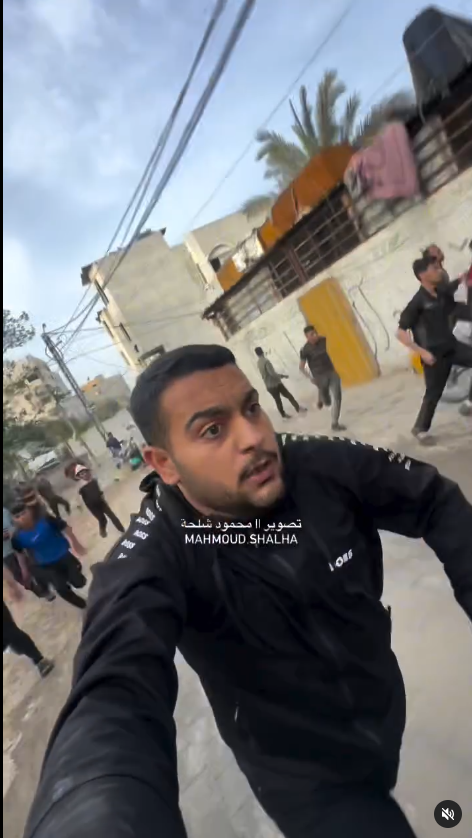
Figure 3: Israeli targeting a gathering of citizens while they were digging a well in the Saftawi area in Northern Gaza.
Source: @mahmoud.b.shalha. May 18, 2025.
On the other hand, the intermodal juxtaposition of the elements (Figure 2) with the sense of raw immediacy visible through @wizard_Bisan’s verbal testimony constructs an evidentiary frame for her articulated message. It equally shows the user’s platform fluency as she manipulates its affordances and vernacular for establishing a more Insta-native content optimized for user engagement.
Through the aesthetics of urgency, primarily, coupled with experiential (from-the-ground) knowledge, Instagram has also allowed for the emergence of (b) user-war influencers. Invoking the definition provided by Divon and Krutrök (2025) in the context of the Ukrainian war, this category refers to “ordinary users who live in conflict zones, rising to fame, influence and status from near-complete anonymity in times of war.” Though citizen journalists can fall under this broader category (@saleh_eljafarawi, primarily), the distinction was made on the basis of this group’s occasional – or eventually, permanent – collaborations with news outlets.
Though the ‘echo chamber’ that took shape through the crawling process did connect to accounts of Sudanese reporters and/or photographers – such as, @faizbubak – a close examination of the accounts’ feeds did not display content consistent with the immediate and video coverage style of the Palestinian witness-based prosumers. @faizbubak’s Insta posts’ design remains rooted in the practice of “war photography” providing a static image with a caption meant to capture the visual’s main message (Figure 4).

Figure 4: “2025- A citizen searches for his car amid the destruction.
Source: @faizbubak. April 27, 2025.
‘Politainment’
@2jomaa (Ahmed Jomaa)’s updates have contributed to his “(micro)celebrification” (his account has over 1.4M followers) through his infusion of the political with the entertaining, adopting as such the Insta vernacular and adapting it to his documentation of the violence. Trends – i.e., viral content formats, trending sounds, and buzzworthy topics– find their way into his videos (Watson 2024). Instagram identifies trending sounds, and formats in mediated content algorithmically boosting such videos to more users. @2jomaa’s choice to ‘join the viral trends’ increases the visibility and reach of his content. Indeed, “using memes to confront adversity has become a defining feature of platform vernacular evolving into a distinctive dialect that serves as a strategy for gaining recognition, especially among Gen Z creators” (Divon and Krutrök 2025). As such, blending memetic elements, trending audios and playful videos into everyday-life scenes from within Gaza makes Ahmed’s content familiar and relatable among Gen Zers (Figure 5). His witty style, however, is more satirical than it is amusing since it is an attempt to vehicle the absurdity and the injustice of life under an expansionist colonial state.

Figure 5: Instagram creator Ahmed Jomaa recreating a trendy video with children in Gaza.
Source: @2jomaa. April 17, 2025.
Political Infographics
Despite the diversity in themes and objectives, the remainder of the perused accounts evince the popularity of a very specific content format: the infographic. Since Instagram is, primarily, a visual platform, the space for textual elements – the optional caption – is limited to 2,200 text characters that is “obscured with the ‘see more’ option” when it surpasses 125 characters (Pompilius 2021). While the textual overlay allows users to, resourcefully, superimpose descriptions or comments over posted images or videos, the tendency towards maintaining a polished and coherent feed in the Insta sphere means that the overlay affordance, in its spontaneity, is better suited for the stories feature. Insta culture is driven by a need to keep content together through a cohesive aesthetic that runs throughout the feed making it visually appealing and thus attention-grabbing. This aesthetic can manifest itself through a coordinated color palette, a consistent layout and similar design rules creating a visual identity for the account. Infographics thus have emerged as the optimal media format to maintain this desired seamless ’vibe’ or brand of the account.
Infographics are not native to Instagram nor are they a contemporary development; yet on the platform, the ‘carousel’ or ‘spam’ feature which allows for up to 20 images – as of 2025 – in one post seems to provide ample space for creativity in their design and message. Constituting a hybrid communicative format – a blended textual-visual format – the infographic is growing “particularly adept at conveying political messages. It has thus become immensely popular as a tool for political parties, activists, think tanks, and simply concerned citizens using Instagram to promote their political stances” (Pompilius 2021). In this specific context, the main objective of @letstalkpalestine (LTP) – the self-declared “Instagram’s Palestine Wikipedia” is to disseminate educational content through the infographics across a network of accounts posting in seven languages (focus was placed only on the account posting in the English language). On the other hand, @sudan.updates’ feed is an outlet to a miscellaneous multimedia content dedicated to “amplifying Sudan,” yet infographics seem to make their way into the assortment. Indeed, @sudan.updates seems to disregard the cohesive feed concept conventionally integral to the Insta ecosystem in contradistinction to LTP. While @makanrights’ Insta biography categorizes it as a “charity organization,” browsing the feed draws attention to their use of the infographics format to disperse knowledge.
What strikes Insta users scrolling through the 89 posts (since October 2023) on @letstalkpalestine’s feed in addition to the more than 30 infographics on @makanrights’ account is the meticulously curated, well-sourced and cross-modally composed infographics which renders them comparable to standalone concise research papers. Indeed, the infographics in question present a complex composition of visual – image or video - (Figure 6), textual (Figure 7), statistical, and bibliographic content (Figure 8). Often, a trendy audio track is featured with the post through the built-in sound option.

Figures 6-8: Infographic analyzing “what a second Trump presidency means for Palestine.”
Source: @letstalkpalestine. January 21, 2024
In tandem with the independent initiatives of said “educational” accounts, independent media outlets and think tanks dominated by young creators have adopted comparable strategies. Indeed, Tunisian @inkyfada.media (posting in Arabic and French), @raseef22 (running separate Arabic and English accounts) and @al.shabaka are using these textual-visual templates to summarize dense research papers and/or articles. Published with attached links – either in the caption or in the LinkTree in the biography – the aesthetically consistent visuals, the use of attention-grabbing hooks, and bullet points have the potential to capture the attention of young users, perhaps even pushing them to engage in reading the full article.
Discussion: Reclaiming the Narrative through the Aesthetics of Mediation and Mobilization
The echo chamber surveyed through the crawling strategy substantiates existing literature on the political undertones of Arab-youth, digital-driven creator culture and its centralization of “micro expressions of resistance, social critique, and counter publicity shrouded in ridicule [and] humor” (El Marzouki 2021). Analyzed information visuals across the self-proclaimed witness-based, educational, and community accounts evidence that violence sites continue to take center stage across the perused sample. Both Sudan and Palestine have harnessed a network of young Insta activists seeking to internationalize their causes and educate users on the historico-political situation in both countries.
On the selected corpus, ‘the war chronicles’ format appears to elicit attention specifically in the context of Palestine more than in any violence-affected site in the MENA region. This is attributable to several factors. First, the colonial state of Israel, more often than not, restricts the access of foreign press to Occupied Palestinian territories. On January 9, 2024, the Israeli Supreme Court ruled against the Foreign Press Association’s appeal for “independent access for journalists and media workers in Gaza” (The International Federation of Journalists 2024). Second, journalists – predominantly Palestinians – continue to be targeted by the Israeli Occupation Forces (IOF) with impunity. In 2025, the International Federation of Journalists (IFJ) recorded that in “two years of war, over 223 Palestinian journalists and media workers have been killed in the deadliest period in the history of journalism” (IFJ 2025). This culminates in a vacuum when it comes to independent coverage which converges with the centrality of the Palestinian struggle for decolonization in the MENA citizens’ public consciousness, and the long-standing culture of anti-colonial activism, sets the ground for the increasing interest in the independent alternative from-the-ground reporting/coverage of Insta users.
Asserting themselves against propaganda and disinformation, the witness-based creators simultaneously amplify the aspect of “social belonging” (Hassoun et al. 2023) while internationalizing their narratives (Eder et al. 2025). What distinguishes journalistic reporting on Instagram from professional broadcasting is the entanglement of the semiotic elements of witness and narrative. The carefully worded over-sensationalized headlines, the handpicked images and the manipulated audio-visuals of yellow journalism are supplanted by mobile phone “raw, selfie-style videos,” as seen in figures 1 and 2 (Kaur 2024).
Such videos can be taken in the moment of action, or they can take the form of updates – especially after major internet or general electricity blackouts. The first-hand, unscripted, unedited, minute-by-minute, and user-generated video coverage from the ground sometimes results in messy and visually chaotic clips (Figure 2). Notably, the convergence of camera shakiness, unedited cuts, and the unfiltered background noise that seeps into their posts is in its own right a multimodal mode of meaning-making that is meant to communicate trustworthiness. This format is exemplified on Bisan Owda’s feed (Figure 1) culminating in her widely recognized opening expression “it’s Bisan from Gaza and I’m still alive,” which ultimately became the title of her AJ+ documentary which earned the 25-year-old an Emmy Award (Tape 2024).
Repurposing the Insta artistic initiative of artist and musician Don Christian Jones in the aftermath of George Floyd’s murder in the United States, the analyzed videos are driven by an ‘aesthetics of urgency’ (Trouillot 2021). For the purpose of sketching out the transformations in political communication that are occurring in the Insta space, it is pivotal to highlight that this format of messy videos is relatable to youth who have a tendency to create similar chaotic content for their Insta stories or live features. Moments ranging from their everyday lives to major events are shot with a mobile phone and make their way into their own accounts unfiltered, even if it is only for 24 hours. In Tunisia, for example, coverage of protests is largely disseminated through this format of impromptu documentation. Indeed, the multimodality (mixture of textual and sensory elements) of their content, its personalized, amateur-like style (departing from the sophisticatedly produced segments of broadcast channels) translates to a level of credibility that reinforces the affective aspect of the self-organizing networks of the connective action framework (Bennett and Segerberg 2012).
Often, testimonial videos further showcase the digital savviness of their creators, as indicated in the findings. Through montage and transposition of images/videos, Bisan, Mahmoud, and Saleh, create visual narratives connecting disparate events to provide an overview of a certain situation on the ground. Nevertheless, it is mostly the coverage of atrocities, especially in the event of escalations that generates the highest levels of interaction (Table 1). While the account of @saleh_eljafarawi was taken down by META at the time of writing this article, his last analyzed post has exceeded 110k (likes + comments + shares) whereas @mahmoud.b.shalha’s top post has accumulated over 919k.
Comparatively reading our findings within the broader literature on digital politics, especially against studies on TikTok, indicates a similarity when it comes to the practice of “playful activism” (Cervi et al. 2023; Divon and Krutrök 2025). @2jomaa’s trendy video activism, mixed with visually aesthetic colors of the infographics, makes the content within this digital enclave “relatable, tangible, and accessible to broader audiences” (Cervi et al. 2023). However, while Cervi et al. (2023) indicate that TikTok evinces a “messy and unorganized” environment, on Instagram, the ubiquity of infographics builds in most cases a relatively homogenous visual feed. This format does represent a “captivating content that marks a departure from the more traditional, text-heavy forms of communication” (Murtaza 2024). Furthermore, though rich in styles, infographics provide short, digestible forms that could be easily consumed rendering them appealing to the population of study which generally, as previous research has suggested, seeks “short-form content on social media, where they could swipe … or scroll when overwhelmed or uninterested” (Hassoun et al. 2023). Their multimodality furthers this swiping strategy as users can ignore the textual elements and focus on the visuals, or vice versa.
As is manifest in LTP’s multilingual project and the centering of the English language on other accounts, the target of these content creators is not merely the Arabic-speaking audience of users on Instagram; they are rather attempting to amplify narratives from within at an international scale. Whereas in 2007, Warf and Vincent (as quoted in Jahshan 2014), inferred that “the Arab world plays a relatively minor role in the rapidly changing geographies of global cyberspace” given the “dominance of the Latin alphabet” on the digital sphere, these emerging forms of political communication are occasioning the need for a re-reading of the politics of the virtual space.
By dint of infographics, these young creators are engaging in a project of correcting historico-political knowledge on the region thus bypassing established forms of manifest and latent orientalism. From “fact-checking” data (@letstalkpalestine, 2024) to “debunking” myths surrounding Sudan and Palestine (@letstalkpalestine, 2024), the Orient is being reshaped and reconstructed in “counter-hegemonic ways of re-writing the self” (Jahshan 2014). Invoking Pintak’s analysis of the media content of Arab journalists (2009), it can be argued that networked platforms contributed to the rise of a “revolutionary consciousness” which on the borderlands of the Middle Eastern and North African identity is “shaping an emerging ‘imagined’ watan (Latinized Arabic word for Home) … that, in some ways, transcends the traditional lines in the sand that define the nation-state.”
Interestingly enough, this emerging identity is not being shaped in isolation but is rather focused on the ‘connectedness of struggles’ as infographics show. The Palestinian question and the Sudanese struggle are being framed in terms of geopolitical machinations and forms of racialized violence that have their roots in similar historical experiences, but also in terms of the intersectional nature of contemporary challenges – environmental, racial, economic, societal inequalities. (see further posts on @letstalkpalestine such as “Black-Palestinian solidarity” [February 2024] and “The Namibian Genocide 1904-1908” [April 2024], among others).
Beyond deconstructionist objectives, infographics have also become a vehicle for calls to action, revealing an aesthetics of direct activism. Bypassing mere performative posting or slacktivist tendencies, analyzed accounts are capitalizing on the potential for international reach to raise awareness, announce fundraising initiatives, incite diaspora-based audiences to lobby their host country’s government and/or government representatives to their cause, among other initiatives.
Conclusion
The study of the multimodal-political content creation through the social media ecosystem allowed us to uncover the defining features and strategies that distinguish the MENA politics echo chamber. In this specific context, MENA prosumers on Instagram are evincing new configurations of participation and identification through content creation. The intensification of the War on Palestine since October 2023 – as findings in this article showcase – has resulted in an upsurge of instantaneous video coverage blending testimony and story-telling departing with the spectacularized and sensationalized coverage of mainstream media. Though the use of Instagram infographics activism has reached its peak during the 2020 Black Lives Matter campaign in the United States, MENA users have adapted this format to center Palestine and Sudan.
The human-centered pivot of disseminated videos and the evidence-grounded nature of infographics suggest an a priori perception of the social responsibility that creators uphold in their framing, mediatization, and representation of the region’s political developments to an international audience. While a cross-platform analysis can evince a broader variation in terms of engagement, and content format, this analysis centered around the Insta sphere establishes the idea of a “demotic” turn among MENA users. Succinctly, through platforms such as Instagram, political communication is, in the words of Turner (2006), shifting “from being something imposed from above by media producers to something actively produced and consumed by ordinary people.”
Index A: The Initial Log before Selection of the Sample (May 2025)
| Account Handle | Initial Data Discovery | Account Type | Source for Classification | Follower Count | 5 Baseline Posts | Description of Dominant Modality* |
| @wizard_bisan1 | Geotagging feature | User war influencer/citizen journalist | As defined by (Divon and Krutrök 2025). | 480k | May 17, 2025-May 07-2025 | Videos with superimposed elements |
| @mohammedHarar2 | Profile suggestion via @wizard_Bisan1 | User-war influencer. | As defined by (Divon and Krutrök 2025). | 168k | January 19, 2025-October 07, 2024 | Videos and images |
| @ezz.lulu | Geotagging feature | User war influencer | As defined by (Divon and Krutrök 2025). | 617k | April 22, 2025-March 21, 2025 | A mix of videos and images |
| @2jomaa | Geotagging feature | User war influencer | As defined by (Divon and Krutrök 2025). | 1,3m | May 11, 2025-May 17,2025 | Videos |
| @sudansolidaritycollective | Hashtag search (”#SudanUpdates”) | Community account | Instagram bio | 32k | May 11, 2025-May 01, 2025. | Infographics (linking to workshops, donation initiatives..) |
| @sudan.updates | Hashtag search #SudanUpdate | Educational and community account | Based on the centrality of both infographics and news updates | 165k | May 12, 2025-May 06, 2025 | Infographics |
| @helpingsudan | Profile suggestion via @sudan.updates | Charity organization | Instagram bio | 1990 | May 13, 2025-March 23, 2025 | Infographics |
| @inkyfada.media | Keyword search (“MENA politics”) | Independent news outlets | Bio | 17,2k | May 11, 2025-May 07, 2025 | Infographics |
| @raseef22 | Profile suggestion via @inkydafa.media | Independent news website | Bio | 371k | May 15, 2025 (the five posts are from the same day) | Infographics (with links to blogs/articles) |
| @faizabubak | Geotagging feature | “Sudanese photojournalist” | Bio | 11,7k | May 08, 2025-April 16, 2025 | Images with captions |
| @ala.kheir | Profile suggestion via @faizabubak | Photographer/curator | Bio | 8770 | April 18, 2025-03 March, 2025 | Images with captions |
| @saleh-eljafarawi | Key word search (“Gaza”) | Citizen journalist/user war influencer | As defined by (Divon and Krutrök 2025). | 753k | May 14, 2025-May 09, 2025 | Videos |
| @makanrights | Hashtag search (#Palestine) | Educational account | Instagram bio | 13,5 | May 15, 2025-March 13, 2025 | Infographics (featuring links to papers) |
| @mahmoud.b-shalha | Profile suggestion via @saleh-eljafarawi | User war influencer/photo journalist | As defined by (Divon and Krutrök 2025) / Bio | 279k | May 18, 2025-May 16, 2025 | Videos |
| @letstalkpalestine | Keyword search (“Palestine”) | Educational account | Bio (“Instagram’s Palestine Wikipedia”) | 975k | May 15, 2025-April 13, 2025 | Infographics |
| @al.shabaka | Profile suggestion via @makanrights | Policy network/Global Palestinian think tank | Instagram bio | 13.5k | May 15, 2025-April 15, 2025 | Infographics and videos (linking to papers, podcasts) |
| @7amleh | Profile suggestion via @al.shabaka | Educational account | Bio (focus on “#DigitalRights, #Human Rights). | 25,2k, | May 15, 2025-May 14, 2025. | Infographics (linking to webinars, workshops) |
| @watermelonmovement | Geotagging feature | Community account | Bio | 75k | May 11, 2025-April 11, 2025 | Images and videos |
| @sabarprojectorg | Profile suggestion via @watermelonmovement | Educational account | bio (“historical research”) | 13.1k | May 15, 2025-April 04, 2025 | Infographics |
| @teachingpalestine | Profile suggestion via @sabarprojectorg | Educational account | Bio (“an intellectual project”) | 3885 | April 23, 2025 – March 11, 2025 | Images (calls for paper, conferences, infographics) |
*Data compilation stopped once qualitative diversity was noted in the elements described from the posts.